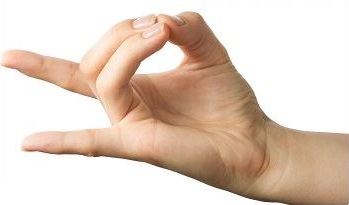

The word Mudra is derived from the Sanskrit words Mud+Dhra, or bliss+dissolving – meaning that which dissolves duality and brings together the deity and the devotee. Mudras are gestures performed with the hands and are used to convey various feelings, or expressions or meanings. (Recently the the famous Australian cricketer Greg Chappell showed the notorious “middle finger mudra” to the Ganguly fans at Kolkata!!).
The use of the Mudras is quite common in the Hindu Poojas, Tantric worships, Yoga and also in Classical Indian dances. In Hindu iconography, the deities are often depicted with their hands making various Mudras – like the twin gestures of dispelling fears and granting boons. Various deities have several specific Mudras which are associated with them. They are used by the practitioner for various purposes – like activating the various nerve centers, to convey a feeling or to appease a deity etc.
Each finger represents one of the five elements—the thumb is agni (fire), the forefinger is vayu (air), the middle finger is akash (ether), the ring finger is prithvi (earth) and the little finger is jal (water).
Please note that in Natya Sastra (classical dance) and in Yoga also there are several similarly named Mudras which are at times quite different from the Pooja Mudras. For example the Yoni Mudra used in Yoga is totally different from the Yoni Mudra used in Pooja.
Mudra Therapy: Several Mudras are also used for improving health. The following are a few commonly recommended ones.
Akash Mudra : For Ear problems Dhyan Mudra : For Concentration power, Depression, and for all Mind related problems Hridya Mudra: For Heart disease, Asthma, and Respiration related diseases Jala Mudra : This is for blood purification and all skin diseases. Prana Mudra: Eye problems, Nervous problems and charges all parts of the body. Surya Mudra: Obesity, Cholesterol etc. Vayu Mudra: For joint pains, stomach problems etc. Prithvi Mudra: For peace of mind, Energy etc.
Various Types of Mudras
Gyana Mudra
Joining tip of the thumb with that of the index finger forms this alignment. This is particularly beneficial for increasing the brainpowers of memory and concentration. Also recommended during meditation, this Mudra provides a soothing and calming effect to the mind. Those suffering from mental ailments like depression, anxiety, loss of sleep, stress etc may find relief on practicing the same. Not only this, in case you tend to remain angry and irritable in everyday circumstances and lose your cool easily, try this mudra and find the difference.
Dhyana Mudra
In this Mudra, you simply need to overlap your left hand with the right hand and keep steady in your lap. This alignment of the hands also tends to soothe your tensed up nerves. Practice this regularly to combat the everyday stress and strain and also for meditation. Varuna Mudra This Mudra is formed when you touch the tip of your little finger to that of your thumb. As specified earlier, the little finger represents the water element. Thus, the Varuna Mudra is particularly beneficial for dehydration. This may be also practiced for dry skin problems and it also works as natural blood purifier.
Surya Mudra
This mudra is news for all those who are evidently concerned about their expanding waistlines. This alignment has been particularly recommended for combating heaviness and obesity. For this particular alignment, you need to simply fix the ring finger in the root of the thumb and press the thumb over it.
Aayu Mudra
This may be rightly termed as ‘Pain killer’ alignment of the hand. The index finger is established in the root of the thumb and pressed with the thumb. Air or Vatta (being the root cause of pain in the body) is suppressed by the fire causing a reduction in the same. This is recommended for the patients of joint pains.
Prithvi Mudra
Prana Mudra
This mudra has been especially designed for attaining immune power so as to stay clear of body as well as mind disease. Also, it imparts a glowing complexion to the skin as it radiates blood-purifying properties. It is also beneficial for those suffering from eye ailments. For making this hand alignment, you need to join the tip of the thumb with tip of little and ring finger. Keeping other two fingers straight.
Apana Mudra
In this particular alignment, you need to touch the tip of your thumb to the tips each of middle finger and ring finger. The index finger and small finger should be held upright. Those suffering from frequent problem of abdominal wind may attain relief on practicing this mudra.
Linga Mudra
For respiratory maladies especially with increased phlegm and secretions, this mudra comes as help. It is particularly recommended for asthmatic patients and also for those who have increased ‘Kapha’ in their body system. All you need to do is to clasp the fingers of both hands together and keep one thumb upright.
Hridya Mudra
This mudra has been particularly designed for the heart patients. Patients of high blood pressure and palpitations may drive favourable results from practicing the same. The index finger is to be kept steady in the root of the thumb. Next touch the tip of the thumb to that of the middle finger and ring finger together. Keep the little finger straight up.
Shunaya Mudra
The middle finger is to be kept at the base of the thumb and the thumb exerts little pressure on it. This alignment may be tried at the time of pain in the ears. Those suffering from diseases of the gums may also benefit by the same.
A lot of people want to know and use the Mudras during Pooja and Tantrik worship but do not know the correct ones. We are giving bellow 40 of the most commonly used Mudras in the various Poojas and Tantric worships so that those interested can learn them an practice. Click on each name to see the picture of the Mudra in a new window. These are the correct Mudras, but in some sects there are minor variations. Other pages of interest >The Shodasa (16) Upacharas in Pooja
Ankushamudra
Apanamudra
Avahanamudra
Bandhananamudra
Chaturashramudra
Dhenumudra
Gyanamudra
Kaulinimudra
Lelihanamudra
Matsyamudra
Mrugimudra
Mudgaramudra
Pranamudra
Ripujivhamudra
Samanamudra
Sammukhimudra
Sankalpamudra
Sannirudhamudra
Sannitapamudra
Sansthapanamudra
Sarvabeejamudra
Sarvakarshinimudra
Sarvakhecharimudra
Sarvamahankushamudra
Sarvasankshobhinimudra
Sarvavashankarimudra
Sarvavidravinimudra
Sarvonmadinimudra
Soubhagyadandinimudra
Stapanimudra
Suvruttamudra
Tarpanamudra
Tatwamudra
Trikhandaamudra
Udanamudra
Upasamharamudra
Vyanamudra
Yonimudra